

The Low-Income Housing Tax Credit (Housing Credit) is our nation’s primary tool for financing affordable rental housing in rural, suburban, and urban communities alike. A successful public-private partnership, the Housing Credit has financed 3.8 million affordable homes since 1986, serving 8 million low-income households, including families, veterans, seniors, people with disabilities, and people who were formerly homeless.
Advocate for Affordable Housing Today
The AHCIA:
Legislation to Provide More Affordable Homes
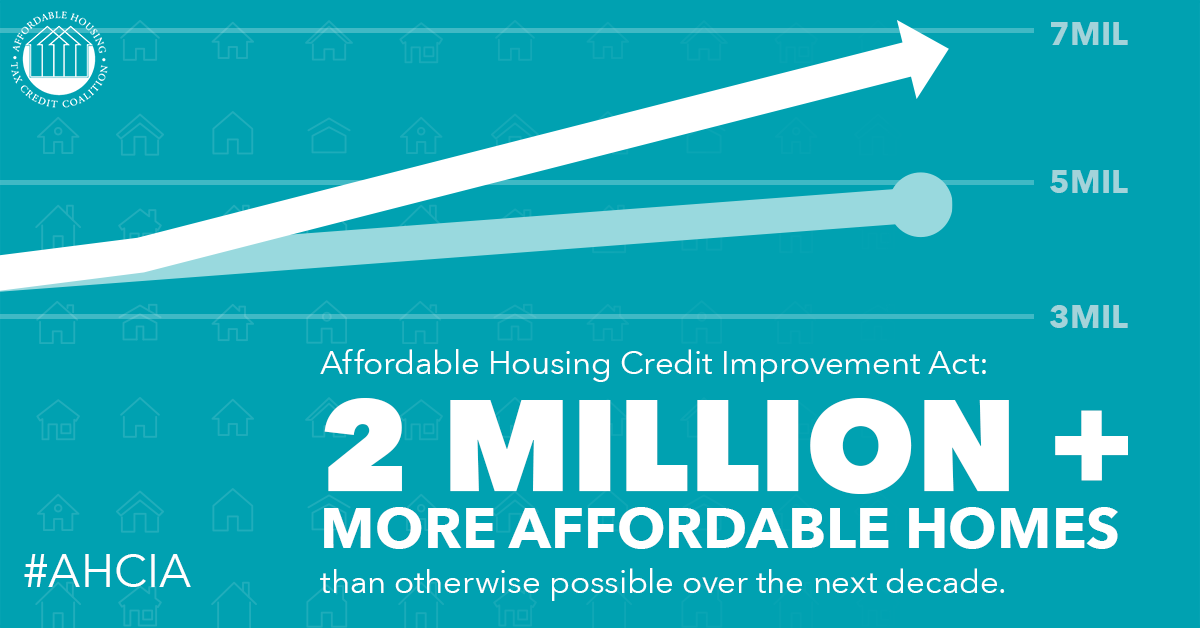
The Affordable Housing Credit Improvement Act (AHCIA, S. 1557/H.R. 3238) is bipartisan legislation to strengthen the Housing Credit and provide nearly 2 million additional affordable homes over the next 10 years, generating nearly 3 million jobs, $333 billion in wages and business income, and $115 billion in tax revenue. Congress should enact the AHCIA to ensure the Housing Credit can serve more low-income households.
Ask Your Members of Congress to Sign On to the AHCIA
Ask your member of Congress, or those who represent the areas in which you work, to sign on to the AHCIA using the information below. If your member of Congress has already signed on, make sure to thank them for working to expand affordable housing in your community! See the co-sponsors of the Senate AHCIA (S. 1557) here, and the co-sponsors of the House AHCIA (H.R. 3238) here. If you don’t know who represents you, find out here. If you need any assistance, contact us.
Constituents can send emails to congressional offices through their Senators’ and Representative’s websites.
In your email, let the staff know if you are a constituent or how much work your organization has done in the corresponding district or state. Request that the member of Congress support the bipartisan Affordable Housing Credit Improvement Act (S. 1557 in the Senate and H.R. 3238 in the House) to provide residents with critically needed affordable housing and to strengthen the Low-Income Housing Tax Credit. Feel free to provide local examples, state- or district-specific data, additional details about the AHCIA, and an AHCIA summary.
AHTCC members can contact us for assistance with email advocacy. We provide email templates and a staff directory so members can directly engage congressional staff who cover the Housing Credit.
Congressional offices track each call they receive to determine which issues constituents care most about. You can find Senate phone numbers here and House phone numbers here.
Phone calls can be short and direct. Provide your name and organization, and let the staff know if you are a constituent or how much work your organization has done in the corresponding district or state. Request that the member of Congress support the Affordable Housing Credit Improvement Act (S. 1557 in the Senate and H.R. 3238 in the House) to provide residents with critically needed affordable housing and to strengthen the Low-Income Housing Tax Credit. Feel free to provide personal anecdotes, state- or district-specific data, and/or additional details about the AHCIA. Provide your contact information in case congressional staff would like to follow up, and confirm that you would like a written response if asked.
Learn how to engage members of Congress in property events here.
Engaging members of Congress or congressional staff in property events is the best way to show the benefit of the Housing Credit in their home state or district. Events can include groundbreakings, grand openings, property tours, property anniversaries, and more, and may take place virtually or in-person.
The AHTCC has developed a step-by-step guide to assist affordable housing advocates in engaging members of Congress and their staff in Housing Credit property events. Please contact us for assistance.
Virtual and in-person congressional meetings are important for introducing new staff to the Housing Credit and affordable housing policy, and answering detailed questions that may decide whether a member of Congress will provide support for the Housing Credit.
For AHTCC members, we facilitate in-person and virtual meetings with members of Congress. Please contact us for more information and learn about AHTCC membership here.
Raising the voices of Housing Credit residents can help to educate congressional offices about the importance of affordable housing and the critical need to provide more affordable housing. Do you have resident stories you’d like us to share? Please let us know. See our resident stories webpage for examples.
To learn how to develop resident stories, see the Where Will We Live Storytelling Toolkit and Resident Story Gallery.
AHCIA Online Resources
AHCIA Document Resources
- AHCIA Summary
- AHCIA Detailed Summary
- New/Updated Provisions for the 118th Congress
- The Urgent Need to Expand the Housing Credit
Housing Credit Resources
Share Your Support for the AHCIA on Social Media
Click the images below to download, and don’t forget to use #HousingCredit and tag us at @AHTCCoalition.

Sample Tweet: The Affordable Housing Credit Improvement Act could finance nearly 2 million additional #affordablehomes over 10 years by expanding and strengthening the #HousingCredit. Congress must pass the #AHCIA today. #LIHTC @AHTCCoalition

Sample Tweet: Since 1986 the #HousingCredit has created 3.8 million affordable homes nationwide. #AHCIA 2023 could add nearly 2 million more over just 10 years. I urge support for this bill on behalf of American working families. #LIHTC @AHTCCoalition
Sample Tweet: Tribal areas have some of the most urgent housing needs in the U.S. I am proud to support #AHCIA to expand and strengthen the #HousingCredit and provide more safe, decent, #affordablehomes for Native communities across the country. #LIHTC @AHTCCoalition
Sample Tweet: High rents make it hard for people with disabilities to find housing with necessary services & amenities. That’s why support for enacting the #AHCIA is so critical: we can build nearly 2 million more #affordablehomes & better serve people with disabilities. #LIHTC @AHTCCoalition

Sample Tweet: More seniors in retirement struggle every day to find #affordablehousing in America. The #AHCIA could provide nearly 2 million more affordable homes across the country over 10 years, helping to meet our nation’s growing senior housing needs. #HousingCredit #LIHTC @AHTCCoalition

Sample Tweet: Providing #affordablehousing is the best way we can serve #veterans who have served for us. The Affordable Housing Credit Improvement Act would finance more affordable homes for veterans who need them most. Congress must pass the #AHCIA today. #LIHTC @AHTCCoalition